See who actually pays the bills
Your customer base isn't uniform. Some place one order and never return. Others become repeat buyers who spend more per order at zero acquisition cost. The Customers page breaks down new vs returning, calculates lifetime value per cohort, and shows you which segments actually drive net profit.
For DTC brands where repeat purchase is the business model, and true profitability depends on who comes back.
Starter+ · Available on every paid plan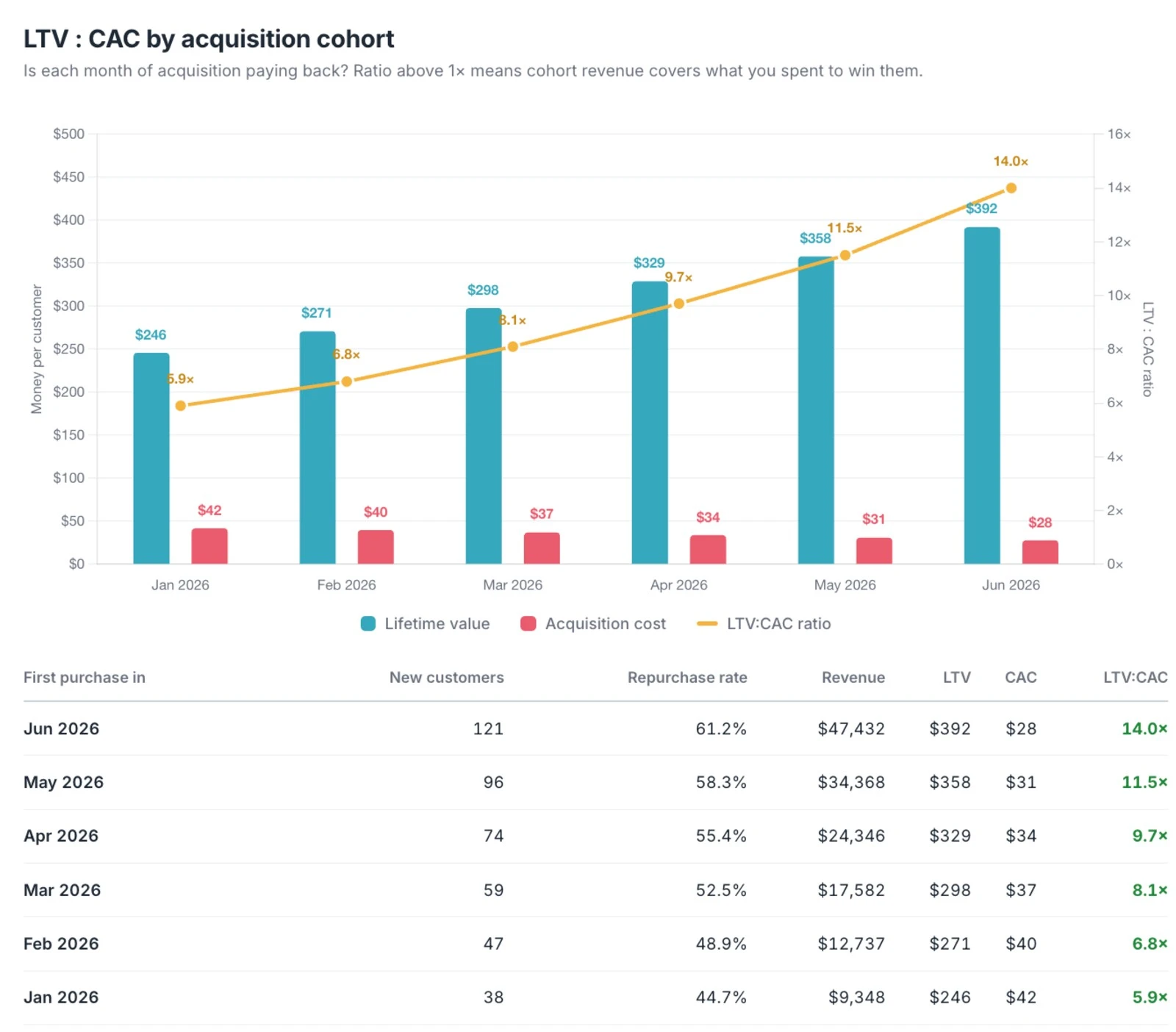
Returning customers are 2-3× more profitable
Returning customers aren't more profitable because they spend more — they're more profitable because you don't pay acquisition costs to bring them back. A returning customer at $80 AOV with zero CAC beats a new customer at $100 AOV with $30 of acquisition spend. Over a year, a customer who orders twice costs half as much per dollar of revenue as a one-time buyer.
If you're running 8% POAS on acquisition but your repeat customers have 35% contribution margin, you're under-investing in retention. The merchants winning on profitability aren't the ones with the highest revenue — they're optimizing customer mix.
Every order, classified automatically
Every order is categorized using Shopify's customer history — new customers have zero prior orders, returning have at least one. The chart shows revenue split and the trend over time. Watch for the percentage of new orders rising or falling as an early indicator of acquisition velocity changes or retention improvements.
Once you see your mix, optimization becomes tactical. A merchant with 30% returning revenue and 20% repeat rate has found their answer: invest in post-purchase email and reduce friction on repeat orders. A merchant with 50% returning revenue but only 12% repeat rate has a different problem — strong PMF but ineffective communication.
Track lifetime value against acquisition cost, by cohort
Customers are bucketed by their first-purchase month. For each cohort, we calculate lifetime value (revenue from that cohort, accumulating over time) and acquisition cost (ad spend in that month, allocated per new customer). The ratio is your LTV / CAC — the single most important number for sustainable growth.
A healthy DTC business runs LTV / CAC above 3×. Below that, you're underpricing or over-spending on acquisition. Above 5×, you're under-investing — you could buy more growth profitably. The chart shows the trend so you know whether the ratio is improving or compressing as you scale.
Every question your retention strategy depends on
Customer analytics in Shopify is shallow — counts and emails. The Customers page answers the questions you'd otherwise need a data analyst for. Every metric maps directly to a decision you'd otherwise be guessing on.
“Are we acquiring profitable customers?”
LTV / CAC by cohort. A 4× ratio is healthy; 6× means under-investing in growth; under 3× means you're paying too much to acquire or selling too cheaply.
“Is retention getting better or worse?”
Repeat purchase rate trend over time. Every 0.5 point improvement compounds — a move from 24% to 27% repeat rate is often worth more than doubling ad spend.
“Should we discount returning customers?”
Compare returning customer margin (35%) to new customer margin (12%). If returning is 3× more profitable, you don't need to discount them — they're already buying. Save discounts for acquisition.
“Which cohort is our best ever?”
LTV by first-purchase month. The cohort with the highest 6-month LTV tells you what was working that month — channel mix, product launches, pricing, retention sequence.
“Are repeat customers buying more or less per order?”
AOV split by new vs returning. Returning customers typically have 15-30% higher AOV — if yours don't, post-purchase upsells aren't landing.
“How much should we spend on acquisition?”
Your max CAC = LTV / 3. If your average LTV is $300, your CAC ceiling is $100 to maintain healthy unit economics. Above that, you're growing unprofitably.
Top customers, retention health, acquisition pace
NetNet flags customer mix shifts before they hurt
You shouldn't have to scan cohort tables every day. The Customers page surfaces shifts automatically — falling repeat rate, rising CAC, cohort LTV compression, retention drops in a specific channel.
Repeat purchase rate dropped 3.2 pts
Repeat rate fell from 28.4% to 25.2% over the last 14 days. Check post-purchase email performance and recent product changes.
CAC rising — POAS at risk
Average CAC up 22% over 30 days while LTV held flat. LTV / CAC ratio compressed from 14× to 9×. Review channel mix or creative fatigue.
Returning customer revenue trending up
Returning revenue % up from 58% to 62% in 30 days. Email and retention sequences are working — consider scaling related programs.